Buriano Bridge
The historic Buriano Bridge across the Arno has inspired artists and writers for centuries, and its presence within the Ponte Buriano and Penna Regional Nature Reserve ideally unites culture and nature. ASDEA S.r.l. took part in the design competition launched by the Province of Arezzo as lead partner of a temporary grouping of professionals (RTP), placing third with its innovative design for the new Buriano bridge.
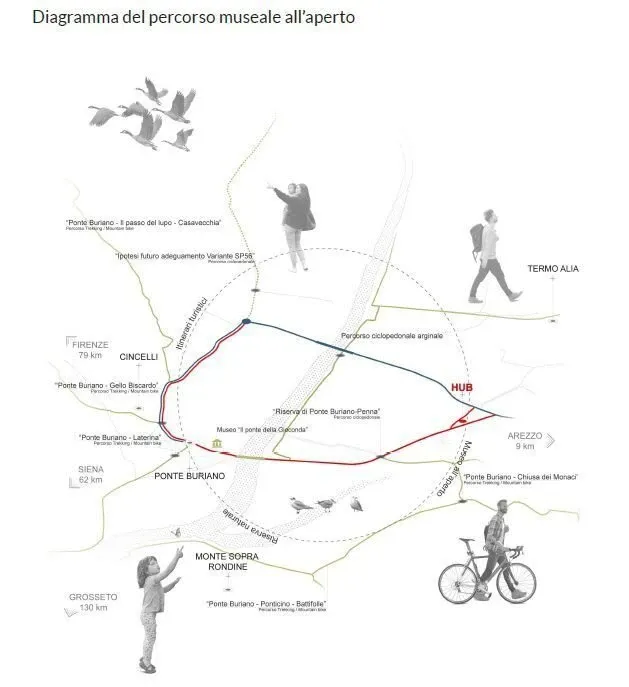
The competition called for the design of a new bridge, connected to a new alternative road system, that would allow the historic bridge to become part of a nature trail. The brief also included the redevelopment of the spaces beneath the bridge along the banks and a coherent integration of the bridge into the nature reserve and the tourist area, placing new emphasis on the whole area as a place for slow and sustainable mobility and integrating and extending the existing cycling and walking paths.
The bridge and the new road system
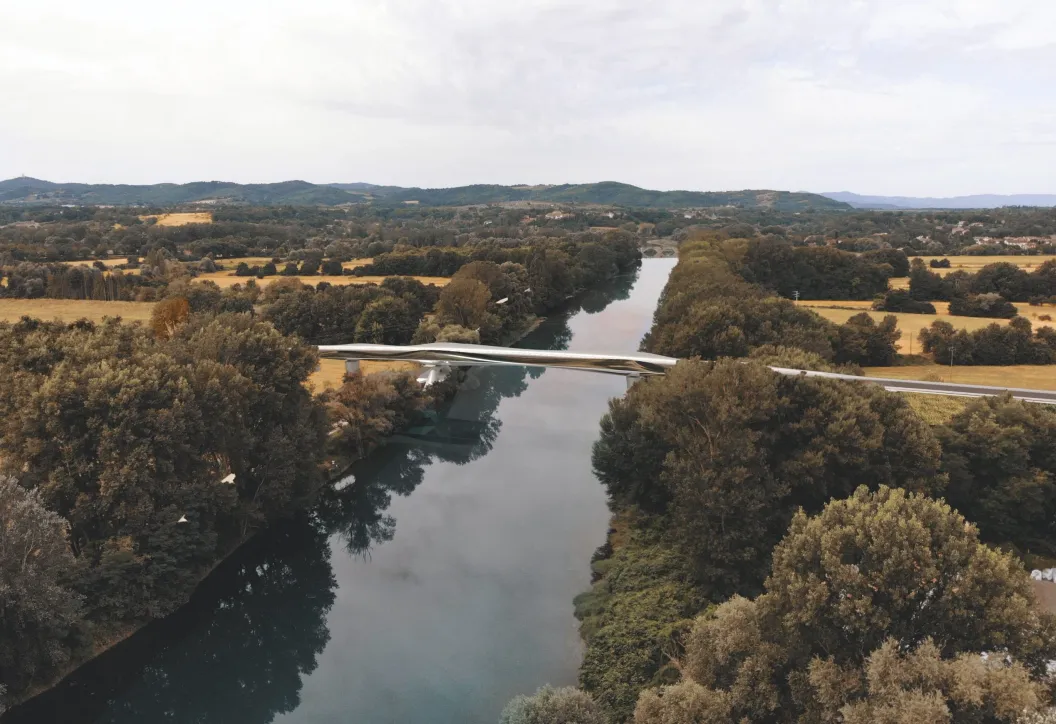
The design team’s proposal consists of a five-span bridge, with spans of 25, 35, 70, 35 and 25 m, set within a new traffic layout.
The new road creates a south–north route through a mainly agricultural and productive area and, after crossing the new bridge, continues to the SP 56 “dello Spicchio” provincial road, which it joins at a roundabout. The SP 56 itself, heading west towards the village of Ponte Buriano, will be upgraded to carry both the traffic of the SP 1 and the cycle path coming from Ponte Buriano. The stretch of the SP 1 across the historic bridge, no longer used by heavy traffic to and from Arezzo, thus takes on a new meaning: it becomes a privileged place for slow and sustainable mobility and a piece of the wider cycling and walking network that has already developed in this area.
A bridge that blends into the landscape
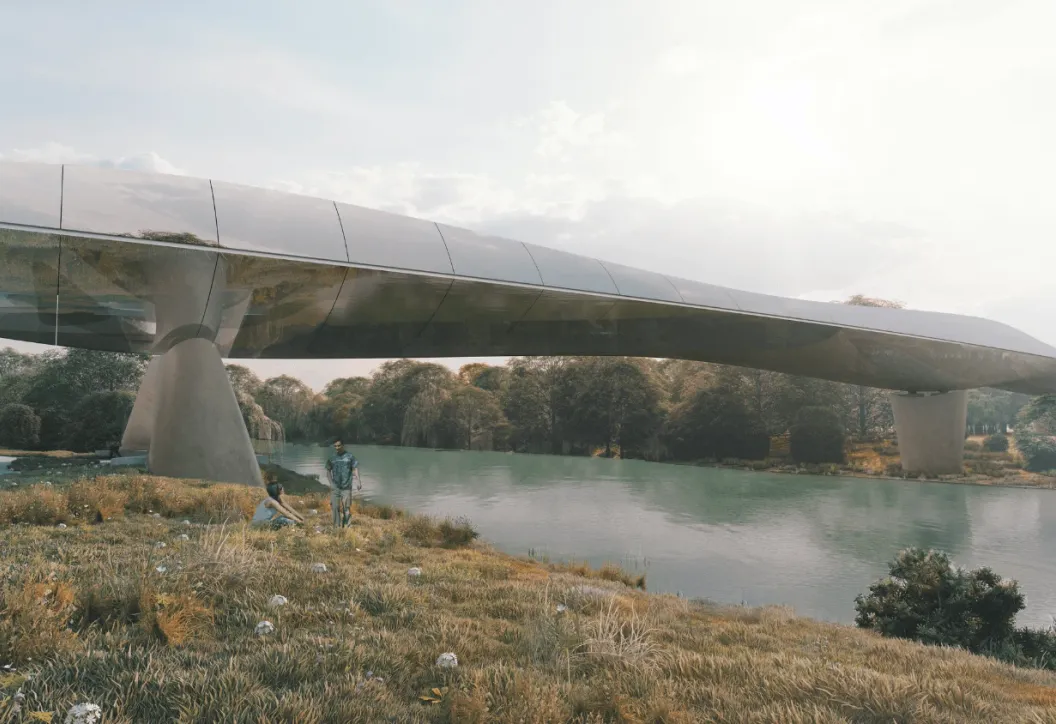
Given the unmatched beauty of the setting, the aim was to design an unobtrusive bridge, “the bridge that isn’t”, fully integrated into the landscape. The design team carefully considered different options before settling on the five-span structure: the central span is wide enough to avoid piers in the riverbed, so the structure does not interfere in any way with the natural course of the river.
Another distinctive feature is the work on the piers: one of them both supports the bridge and connects it to the cycling and walking path. Its arched shape with integrated seating creates a unique and innovative rest area beneath the bridge for pedestrians and cyclists.
A reflective metal was chosen for the bridge’s cladding shell, so that the play of light created on its surface by the movement of the sun and the changing seasons gives the impression of a structure with shifting colours. The bridge thus embodies every shade of the landscape: the blue of clear days and the grey of the clouds, the intense green of the trees and vegetation, the yellows and softer greens of the cultivated fields and, finally, the metallic reflections of the Arno. After a careful study of materials, the choice fell on an aluminium surface with a micro-faceted, non-mirror finish, to avoid unwanted reflections that could disturb wildlife and motorists.
Light as a unifying thread
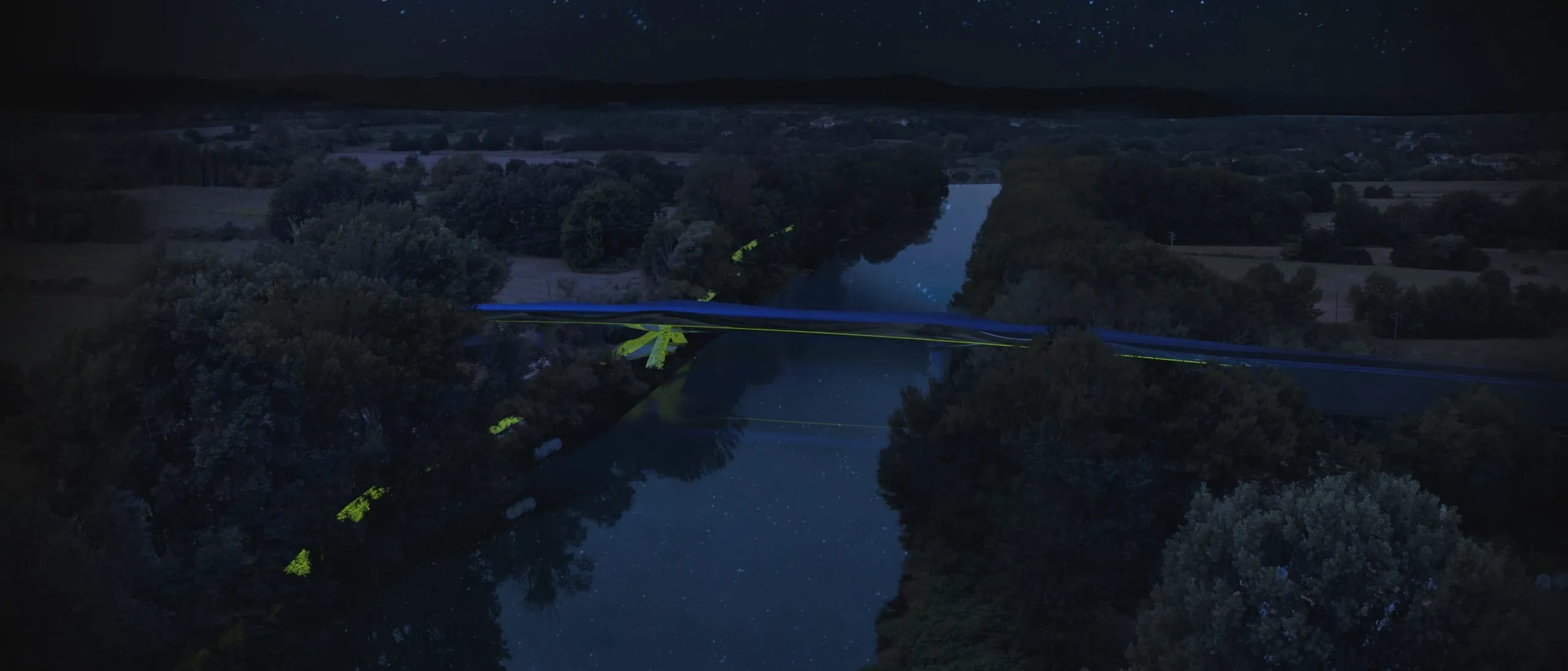
Another innovative feature of the proposal is the use of the range of natural colours and of luminosity as a unifying thread throughout the project, through photoluminescent elements placed at strategic points of the structure. The design includes a central band made of epoxy resins that absorbs sunlight during the day and releases it at night, creating a diffuse green-gold glow. At night the bridge, reflecting the stars, the moon and their reflections on the water, almost disappears into the darkness, and this horizontal line remains the only visible sign of its presence. The solution helps cyclists crossing the area in low visibility and is eco-friendly, as it does not contribute to light pollution.
The tourist route of the open-air museum within the nature reserve is also lit by photoluminescent elements at key points, such as the arches above the rest areas on the riverbank. The arched pier thus becomes a kind of sculpture that identifies the place, and its soft glow evokes the flickering of summer fireflies.
The result is a work of striking simplicity, a focal point of contemporary architecture that blends naturally into the surrounding landscape: a discreet witness to the passage of time that, like the historic Buriano Bridge, may inspire the poets of the future.
Watch the project video on YouTube.
Applied Solutions
- Structural Design & Analysis
- Architectural Design