

Skip to content
Abstract grid of cubic volumes in orange and turquoise

Structural Health Monitoring

Monitoring begins with inspection, survey, and structural identification, carried out through operational modal analysis or artificial intelligence algorithms. MonStr nodes record displacements, velocities, accelerations, strains, cracks, and settlements continuously, 24 hours a day, with no trigger thresholds and no recording windows. The data is written directly into an HDF5 database, ready for analysis.

Turn-Key monitoring system

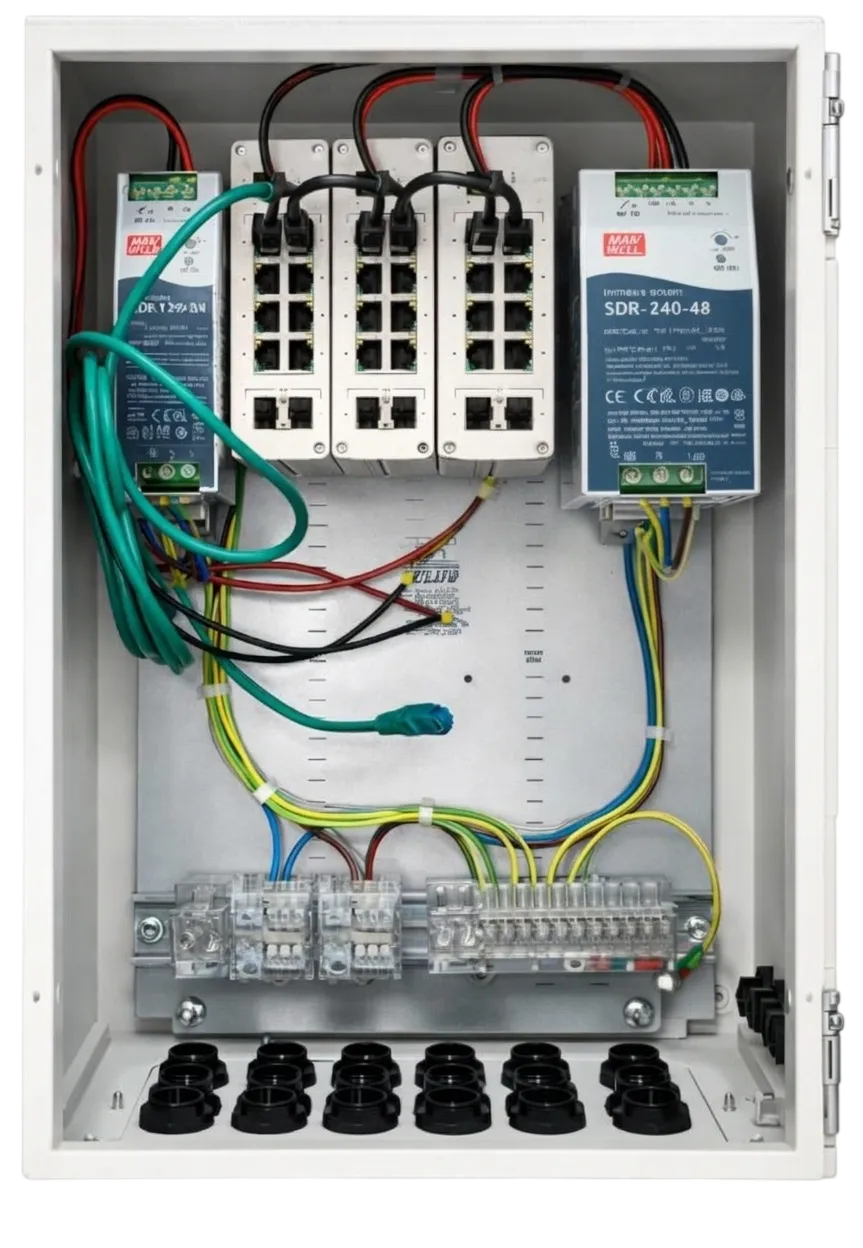
Front view of the MonStr Panel
  • System design

    We define the optimal sensor layout using proprietary algorithms and design the experimental campaign.

  • Installation

    MonStr nodes can be installed in any condition: a single ethernet cable carries both power and data, and each node draws a mere 0.6 W. Connect the devices to the acquisition unit and monitoring starts automatically; nodes and sensors can be added or removed at any time, and common ethernet switches extend the network.

  • Maintenance

    The service covers the design, implementation and management of Structural Health Monitoring systems for the continuous or periodic control of the behaviour of structures and infrastructure. It can include the supply and installation of sensors, data acquisition and transmission, the software platform, the definition of thresholds and alarms, system maintenance and technical reporting.

  • Reporting

    Information and statistics reach the client through the MonStr True Vision web app. On request we also provide the raw data, in HDF5 databases that can be opened with STKO or third-party software.

Abstract composition of transparent panels and glowing data lines on a blue background

Monitoring Technologies

OMA

Dynamic identification under operational conditions. The vibrations recorded during normal operation are processed with time-domain (SSI) and frequency-domain (FDD) techniques. The result is an estimate of natural frequencies, damping ratios and mode shapes, together with their uncertainties. Comparing the mode shapes (MAC) with those of the STKO models makes it possible to update and validate them. In continuous monitoring, the modal parameters, compensated for environmental effects, become damage indicators: a persistent drop in frequencies signals a reduction in stiffness.
Anomaly detection

The artificial intelligence algorithms of our proprietary MonStr AI software process and select the acquired data and automatically detect anomalies: stiffness reduction (from frequencies), crack width, joint damage, displacement anomalies and differential settlements.

Digital Twin

The acquired data feeds two paths at once. Artificial intelligence algorithms identify anomalies in the signals; in parallel, a finite element model calibrated on the same data is continuously updated to follow the changes the structure undergoes. The result covers the entire structure, not only the instrumented points — which is the limit of conventional monitoring. On that model we simulate scenarios, test intervention strategies, and plan maintenance before problems arise.

System integration

All the hardware and software products used for monitoring are developed and produced by ASDEA, starting with the MonStr sensors, and work on the same data format to avoid any loss of precision: measurements are saved in HDF5 databases, the same used by STKO, where data-driven algorithms and model-based tools are managed in the same virtual environment.

WIM

Weigh-in-Motion (WIM) is a system for weighing vehicles dynamically during normal transit, without interrupting traffic. ASDEA integrates WIM into its Structural Health Monitoring systems, pairing the structure's response data with traffic load information such as gross weight, axle loads, speed and vehicle class. This integration makes it possible to correlate the loads that actually crossed the structure with its measured behaviour and to improve the interpretation of monitoring data.

Some projects